06 December 2009

Odyssey Orbiter Puts Itself Into Safe Standby

artist concept of Odyssey
Artist concept of Odyssey Artist concept of Mars Odyssey.

Update:

As of Dec. 3, the Odyssey spacecraft resumed relay operations. Odyssey’s first task was to support a communications relay session for the Spirit rover. Science operations for the orbiter will resume on Dec. 4.

Mars Odyssey Mission Status Report

NASA's Mars Odyssey orbiter put itself into a safe standby mode on Saturday, Nov. 28, and the team operating the spacecraft has begun implementing careful steps designed to resume Odyssey's science and relay operations within about a week.

Engineers have diagnosed the cause of the Nov. 28 event as the spacecraft's proper response to a memory error with a known source. The likely cause is an upset in the orbiter's "memory error external bus," as was the case with a similar event in June 2008.

In safe mode over the weekend, Odyssey remained in communication with ground controllers and maintained healthy temperatures and power. To clear the memory error, the team commanded Odyssey today to perform a cold reboot of the orbiter's onboard computer. The spacecraft reported that the reboot had been completed successfully.

"This event is a type we have seen before, so we have a known and tested path to resuming normal operations," said Odyssey Project Manager Philip Varghese of NASA's Jet Propulsion Laboratory, Pasadena, Calif.

Odyssey has been orbiting Mars since 2001. In addition to its own major scientific discoveries and continuing studies of the planet, the Odyssey mission has played important roles in supporting the missions of the Mars rovers Spirit and Opportunity and the Phoenix Mars Lander.

Until Odyssey is available again as a communications relay, Spirit and Opportunity will be operating with direct communications to and from Earth.

30 November 2009

Comet Theory Faces Mammoth Confusion


Nothing kills a beautiful theory faster than an ugly fact, to paraphrase Thomas Huxley. But what happens when you have three competing theories and two new facts that point in opposite directions? Welcome to the increasingly confusing picture of what happened to the mammoths and mastodons of North America, along with the other dominant mammal species of the late Pleistocene.

For a number of years, scientists have been debating over two possible culprits that might explain the big die-off of megafauna. One is severe climate change, brought about by the onset of the Younger Dryas global-cooling event. Another is overhunting by a newly arrived human population in North America known as the Clovis culture. More recently, a third hypothesis claims that a comet impact or airburst over the Laurentide ice sheet triggered the changes that caused the animal population collapse.

All of these scenarios, or any combination of them, hinge on the fact that the big mammals died off rather abruptly starting around 12,900 years ago. This matches the onset of the climate change and comes right after Clovis appears on the scene. It also coincides with evidence that appears to support the comet hypothesis, including lots of tiny “nanodiamonds” that proponents say may have been generated in the impact and subsequent fires.

Until now, the debate has revolved around what happened. Now there are new questions about when it happened.

In a new paper in the journal Science, Jacuelyn Gill and others suggest that megafauna were in decline well before the 12,900 date. Gill, a doctoral candidate at University of Wisconsin, looked for spores of the fungus Sporormiella, known to grow in the dung of large herbivores. Those spores start to disappear from sites in New York state and Indiana between 14,800 and 13,700 years ago, suggesting an early disappearance for the mastodon.

But wait. Another recent paper by Neal Woodman and others in Quaternary Research finds that a mastodon skeleton discovered in Indiana in 1976 (and now on display at the Cincinnati Museum of Natural History) was dated incorrectly. A new analysis by the Smithsonian researcher finds that the mastodon was alive about 10,055 years ago.

Granted, one mastodon doesn’t make an entire population. But it can’t have been the only one. This means that some of the megafauna survived for thousands of years after they were supposed to have disappeared at the onset of the Younger Dryas, and long after the early decline suggested by Gill.

The commentary accompanying the Gill paper suggests that both the climate change and the impact hypothesis ideas are dead. Instead, the suggestion is that overhunting by paleo-Indians, already established in North America before the Clovis people arrived, is responsible for the early decline.

These conclusions seem premature. What can be said, based on the Gill paper, is that at least some local populations of megafauna were in trouble before the Younger Dryas, for reasons that remain unclear. From the Woodman paper we can infer that some other populations survived well after. And we know already, that an awful lot happened in between — which may or may not have included a comet impact.

It’s ironic that this picture is so confusing when the extinction of the dinosaurs by a large asteroid 65 million years ago now seems quite clear. But this is partly an effect of distance. If we could have visited Earth 12,900 thousand years after the dinosaurs went extinct it’s likely we would have found all kinds of interesting evidence, no longer available, that would have complicated the picture. The loss of the megafauna is both intriguing and hard to understand because it is so recent and there are so many more pieces of the puzzle to play with.

The only solution, as Woodman points out, is even more information. He suggests that mammoth and mastodon fossils in museums around the world should be looked again and redated if necessary to improve consistency in the data. There’s still more work to be done in sampling the environment too.

This debate is far from over. Like North America at the end of the ice age, it’s just getting warmed up.

22 November 2009

Bird's-Eye View of Tranquility Base

Apollo 11 landing site

Apollo 11 landing site
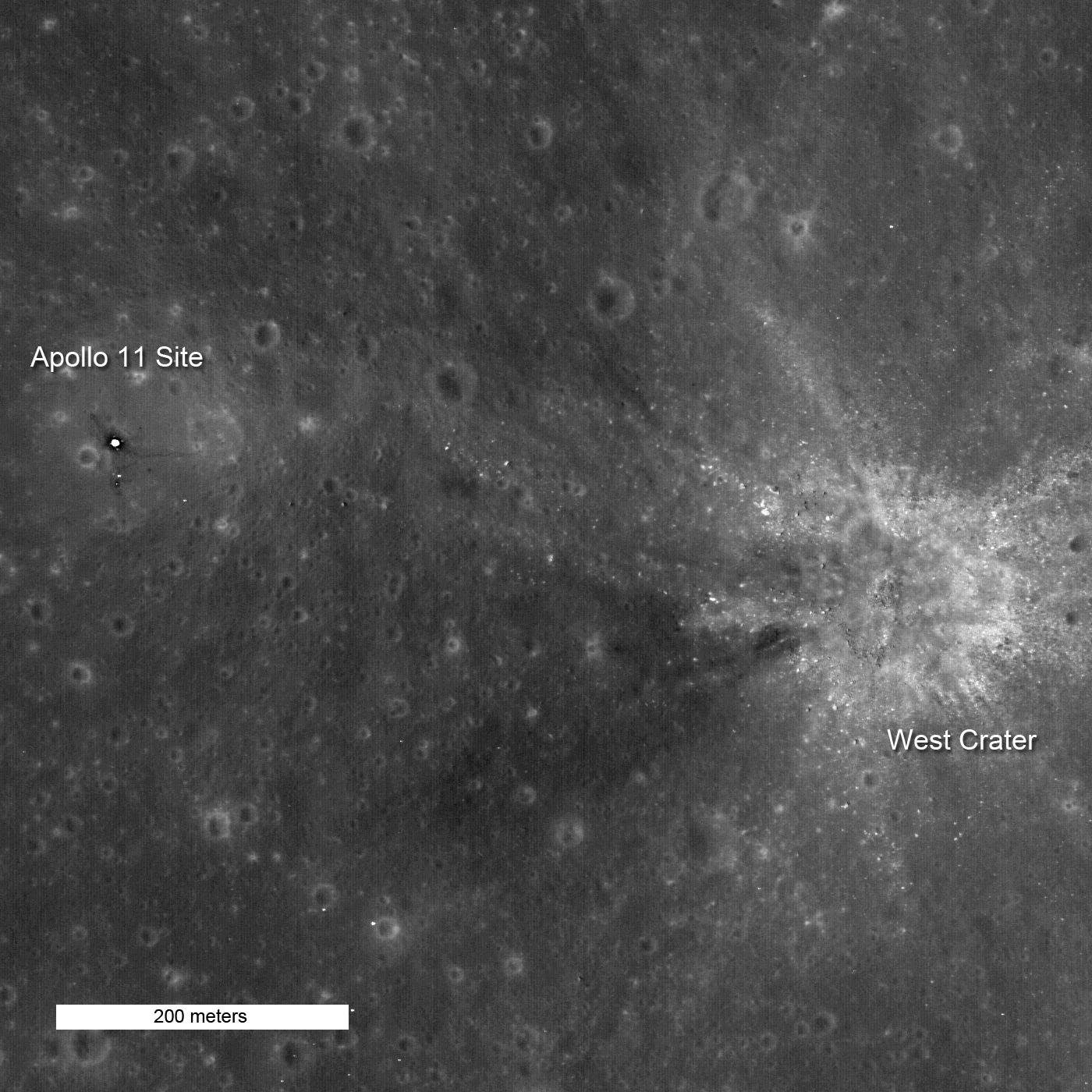
Taken from just 30 miles (50 km) up, this view from the Lunar Reconnaissance Orbiter Camera reveals incredible details at Tranquility Base, the landing site for Apollo1 and its crew in July 1969. Click on the image for a larger view.

Exhibit A is this view of the Apollo 11 landing site acquired on October 1st (but not released until November 9th) by the spacecraft's high-resolution stereo camera, LROC. It reveals details at the Space Age's most hallowed ground down to about 2 feet (53 cm).

Spend a little time perusing the image at right — or go moonwalking yourself by downloading a larger version or even the original image. The LROC team released a lower-resolution view of the landing site a couple of months ago, but now the spacecraft is in its final mapping orbit, a scant 30 miles (50 km) above the lunar surface.

You can easily see the squarish descent stage of the lunar module Eagle, which looks washed out because of contrast enhancement — look closer, and you'll make out its footpads too. Dark trails are the paths made by astronauts Neil Armstrong and Buzz Aldrin as they walked near Eagle and around the Early Apollo Science Experiments Package (EASEP).


Buzz Aldrin on the Moon

Buzz Aldrin on the Moon
Apollo 11 astronaut Buzz Aldrin deploys the EASEP instrument package on Moon, with the lunar module Eagle in the background.

A few weeks ago, the LROC team released a video tour of the Apollo 17 landing site — amazing stuff! I guess those who still believe that NASA faked the lunar landings would argue that these pictures have been doctored.

It's hard to believe, but just a year ago, five spacecraft were orbiting the Moon — none of them launched by NASA. India and China had one each (Chandrayaan 1 and Chang'e 1, respectively), while Japan's Kaguya and two small escorts, named Okina and Ouna, were mapping the Moon inside and out.

Waiting in the wings was LRO, which began circling the Moon last June. Designed and built at a time when the U.S. and its space agency were firmly committed to returning humans to the Moon, LRO is a recon mission in the truest sense. Its seven-instrument payload reflects NASA's desire to understand the lunar features and resources that could influence the design and placement of future lunar settlements.

For example, the spacecraft's low polar orbit should allow its cameras to record the entire globe with 100-meter resolution and up to 10% of the surface with unprecedented 0.5-meter resolution — good enough to spot hazardous boulders in likely landing sites. (In fact, the view here shows boulders from West crater, which lies out of view to the right in the Apollo11 view above.) A radar mapper and a laser altimeter are gauging the slope and roughness of the terrain. The Diviner instrument has been recording temperatures from pole to pole, and a Russian-built neutron spectrometer is finding the "sweet spots" where deposits of water ice lie buried. Finally, a cosmic-ray telescope has been assessing the hazard that space radiation poses for future explorers.

LRO's early efforts concentrated on the lunar poles, in order to pick the best target for LCROSS and the Centaur rocket that carried both craft to the Moon. But Vondrak hopes that LRO can continue clicking and scanning the lunar landscape for at least two more years. Plans call for modifying the orbit periodically to optimize coverage, ending with the spacecraft in a gravitationally stable "frozen orbit" with a low point almost directly over the Moon's south pole.

15 November 2009

The 2009 Leonids Are Coming!


Most meteor showers vary from year to year, but the Leonids are particularly capricious. Many years they chug along producing just 5 or 10 meteors visible per hour. But at the Leonids' historical greatest, in 1833, meteors were seen to fall "like snowflakes in a blizzard," with estimated rates of several dozen per second!

This year is expected to be better than average. The "traditional," most reliable part of the shower should peak around 4 a.m. EST (1 a.m. PST) on the morning of Tuesday, November 17th. You might see 20 or 30 meteors per hour under ideal dark-sky conditions. (Remember, if you want to stay up late instead of getting up early, you'll be staying up Monday night. It's easy to get the date wrong for events that happen after midnight!)

A second, briefer, but very intense outburst is expected about 12 hours later — during the early-morning hours of November 18th in Asia. (See "Will the Leonids Roar Again?".) There's only an off-chance that some activity from that burst will still be going on by the time the Earth turns halfway around and the Leonids become visible in the Americas on the morning of the 18th.

But if the sky is clear, why not go out again that morning — and also before the predicted peak, on the morning of the 16th? The Leonids have surprised the theorists before, and they surely will again.

Wherever you are, no Leonids will be visible before the shower's radiant point (in Leo) rises around local midnight. And peaks and bursts aside, the number of visible meteors increases steadily from radiant-rise until Leo is highest, just as the sky is starting to get light.

Be sure to bundle up warmly; meteor-watching is always colder than you expect. Ideal meteor-watching equipment is a comfortable lounge chair, a warm sleeping bag, and a pillow. If you live in a city or suburb, consider traveling to a dark location far from city skyglow. In any case, find a spot where no lights glare directly into your eyes.

The direction to watch is wherever your sky is darkest. Notice the meteors' flight paths; only those streaking away from the direction to the constellation Leo are Leonids.

Another, less-known meteor shower is going on simultaneously — the Taurids. They're sparse but tend to be very bright. If you see a slow, bright meteor heading away from the direction to Taurus, that's a Taurid.

And you're bound to see a few sporadics that aren't associated with any major shower.

07 November 2009

Strange Brew at LCROSS's Crash Site

LCROSS on final approach
LCROSS and its Centaur rocket prepare to crash into the Moon.


It would be fair to say that the crashy culmination of NASA's LCROSS mission on October 9th was a technical success but a public-relations fizzle.

On the plus side, the engineering team for LCROSS (short for Lunar Crater Observation and Sensing Satellite) delivered as promised, deftly driving a spent 2½-ton Centaur rocket into a target zone near the Moon's south pole only 2 miles (3½ km) across. Four minutes later, after flying through the debris cloud raised by the rocket's crash, an instrument-packed 600-kg "shepherding spacecraft" augered in not far away.

But the team's hope of finding abundant water buried in the permanently shadowed floor of Cabeus, the 61-mile-wide target crater, has yet to pan out. Water molecules have strong spectral signatures in the near-infrared, and even one part water ice in 200 parts lunar dust should have been easy to spot.

So far, the LCROSS team has been mum on what's been found by the shepherd craft's nine instruments, apart from a heavily processed composite image showing a faint puff where the Centaur crashed.

Faint plume from LCROSS imact
Extensive image processing of images taken by the LCROSS shepherding spacecraft 15 seconds after the Centaur rocket's demise reveals a dim debris plume (6 to 8 km across) in the shadowed part of Cabeus crater.

Tony Colaprete, LCROSS's chief scientist, says that the rocket's impact created a pit about 92 feet (28 meters) across, close to expectations. And the debris plume from the crash attained roughly the size and height expected, though he concedes that it was only about a tenth as massive as he'd hoped (nowhere near the 350 tons touted in some predictions).

We may never learn the reasons for the paltry particle production, though right now Brown University impact specialists Peter Schultz and Brendan Hermalyn are saying, "Told ya so!" Their modeling, based on small-scale hypervelocity collisions at NASA's Ames Research Center, suggest that a low yield should have been expected — both because the empty Centaur collapsed into itself as it hit and because the spray of debris went mostly "out" instead of "up."

It's also possible that the Centaur pancaked into the crater's floor. "It was definitely rotating or tumbling," notes observer Marc Buie, who tracked the rocket's final hours with the 2.4-m telescope at Magdalena Ridge Observatory in New Mexico.

All this speculation is intriguing — but "Where's the beef?" you might ask. Colaprete assures me that all the instruments in the shepherding spacecraft got great results, and that the delay in revealing the compositional analyses stems from having lots of spectral signatures to sort through and categorize. Colaprete says some of these findings will be made public in a couple of weeks. (Don't be surprised if he announces that one of the spectrometers did, indeed, detect water in the plume.)

For now, let me tantalize you with a preliminary result from the Lunar Reconnaissance Orbiter, which viewed the Centaur's demise from nearly overhead and just 48 miles (76 km) up. An instrument dubbed the Lyman-Alpha Mapping Project (LAMP) probed the ultraviolet spectrum of the impact plume after it had risen high enough to be projected against black space above the lunar limb.

"We definitely saw something," notes LAMP scientist Randy Gladstone (Southwest Research Institute). But that "something" wasn't water. Nor was it oxygen or hydrogen atoms, both of which have strong ultraviolet emissions. There's some hint of hydrogen molecules (H2) — and though water is one source of hydrogen, it could also have come from silicate minerals, solar-wind gas trapped in the lunar soil, or (most likely) residual fuel in the Centaur's tanks.

LAMP's strongest and most intriguing observation came at the ultraviolet wavelength of 184-185 nanometers. Gladstone says the only known elements able to create that line are iron, perhaps magnesium … and mercury. "Both mercury and iron still look like the best bets for explaining the plume emission we see with LAMP," Gladstone reiterates, though the spectral match is still tentative and more data-crunching is in progress.

Liquid mercury on the Moon? Really? Gladstone directed me to an obscure, decade-old research paper titled "Don't Drink the Water" written by George W. Reed Jr. (Argonne National Laboratory). Reed describes how mercury was found in lunar regolith returned by the crews of Apollos 12, 15, 16, and 17, and other work suggests it might be present in the Moon's wispy-thin exosphere.

No matter what its source, Reed concludes, some of this mercury must end up as deposits in the ultracold interiors of permanently shadowed lunar craters. Moreover, the Centaur slam may not have created the big splash everyone wanted, but it only needed to heat the target area to about 200°F to release any mercury trapped in the dark dirt. And thermal imaging from the Diviner instrument aboard LRO argues that the impact site got that hot and then some.

This is all starting to make sense. Back in mid-September, UCLA scientist David Paige announced, based on Diviner's thermal mapping, that the lunar polar regions are far colder than expected, down near 35 kelvins (-397°F). This means the shadowed floors within Cabeus and its neighbors are the most frigid places known in the entire solar system. More to the point, Paige notes, "The temperatures in these super-cold regions are definitely low enough to cold-trap water ice, as well as other more volatile compounds for extended periods."

So is lunar water safe to drink? Future astronaut crews had better bring along some serious water-purification gear if they intend to live off what they scavenge from the lunar poles.

01 November 2009

Cosmic Blast Rattles Indonesia

Airburst over Indonesia

Back on October 8th, something big lit up the late-morning sky (at about 3:00 Universal Time) over the island nation of Indonesia.

I first learned of this event three days later, when few details were known. A smattering of news reports described an extremely bright daytime bolide that exploded high above the town of Bone in the province of South Sulawesi. One television station showed amateur video of a tortured smoke train lingering in the sky, and unconfirmed reports suggest that a 9-year-old child died of cardiac arrest from the thunderous air show.

Since then, however, impact specialists have been quietly working behind the scenes to try to determine how much punch this cosmic interloper packed. According to a preliminary analysis released October 20th by Elizabeth Silber and Peter Brown (University of Western Ontario), the sky really was falling that day. The blast registered as extremely low-frequency atmospheric waves at 11 of the infrasound stations maintained worldwide by the Comprehensive Nuclear-Test-Ban Treaty Organization (CTBTO).

Silber and Brown note that the high-altitude explosion was centered at 4½°S, 120°E, but it's been challenging to gauge the kinetic-energy punch it delivered. The most likely estimate is equivalent to some 40,000 tons of TNT, about three times the energy of the nuclear bomb dropped on Hiroshima in 1945. If that value is correct, this was the most powerful meteoric blast since 1994, when a "mini-Tunguska," nearly as bright as the Sun, exploded over the tiny Pacific island of Kosrae. Brown and others estimate that events like this should occur about once per decade.

Something this obvious would not have escaped the notice of various defense satellites, because these cosmic intrusions look much like nuclear weapons exploding high in the atmosphere. (Here's a list of previous airbursts picked up by the U.S. military's "orbital assets" and made public afterward.)

It'd take a chunk of asteroid about 20 to 30 feet (5 to 10 meters) across to deliver a 40-kiloton wallop. But no one has yet claimed to have found any meteorites, according to Thomas Djamaluddin, a government scientist who's been monitoring the situation. Odds are that any surviving fragments fell into offshore waters.
Blogged with the Flock Browser

25 October 2009

And Then There Were 400

World in a triple dwarf system
At an international conference on extrasolar planets being held in Portugal, a group of European astronomers unveiled on Monday a list of 30 new exoplanets and two brown dwarfs orbiting more-or-less Sun-like stars. This brings the known exoplanet catalog to a total of 403 worlds.

The new additions were all found by the radial-velocity wobbles that they induce in their host stars, as detected by the HARPS planet-hunting spectrograph on the European Southern Observatory's 3.6-meter telescope at La Silla, Chile.

The European astronomers say that HARPS can measure a star's radial-velocity patterns with an accuracy as fine as 1 meter per second: slow walking speed. This would put HARPS at the head of the accuracy list in the hotly competitive world of exoplanet hunting. Such precision is essential for detecting relatively low-mass planets — not just "super-Jupiters," "Jupiters," and "Saturns" of other stars, but the "Neptunes" and "super-Earths" that are at the limits of current technology.

According to a press release from the European Southern Observatory about the new finds, "HARPS has facilitated the discovery of 24 of the 28 planets known with masses below 20 Earth masses. As with the previously detected super-Earths, most of the new low-mass candidates reside in multi-planet systems, with up to five planets per system."

In particular, says Stephane Udry (Geneva Observatory), the HARPS project suggests that at least 40% of solar-type stars have these smaller planets. "These low-mass planets are everywhere basically."

Limits of Technology

To extract the very slight, periodic radial-velocity changes in a star that signify an orbiting planet, astronomers have to subtract out the much larger continual changes caused by the telescope's own motion on the rotating Earth, Earth's curving motion around the Sun (at about 30,000 meters per second), and even the gravitational influences of the Moon and our solar system's other planets on Earth. All these effects are precisely known. But there may be trickier confounding factors on the distant star itself, such as surface turbulence or starspots that mimic a change in the star's radial-velocity signature as the star's rotation carries the spots around.

Nevertheless, astronomers don't think they've yet hit the fundamental limits of the radial-velocity method for finding planets. For particularly good "quiet" stars, it may be possible to reach accuracies measured in centimeters per second, and thus planets as low-mass as Earth. Such hunts could become possible as early as next year.

Selections from the Harvest

What are the new planets and their stars like? The stars, according to a preliminary list, range from spectral type F6 to M: from somewhat larger and hotter, to much cooler and dimmer than the Sun. The orbiting objects have minimum masses (not necessarily the true mass, but probably not too far off) ranging from 53 down to 0.017 Jupiters. That's from 17,000 down to 5 Earth masses. Their announced orbital periods range from 4 days to 13 years (though HARPS has only been working for five years).

Of special note, three of the planets orbit stars with a lower proportion of heavy elements than are in the Sun — with a "metallicity" of only 1/3 to 1/2 the Sun's. It's well known that the greater a star's metallicity, the more likely it is to have planets detectable. A subgroup of the European astronomers targeted low-metallicity stars in particular, and their finds confirm that planets do sometimes form in a moderately heavy-element-poor environment. Clearly more than this one factor is at work in determining whether a star will have planets, even big ones.

Several systems also show radial-velocity hints of additional objects in longer-period orbits that will require years of further tracking to confirm.

Here's the ESO press release.

Here's the Extrasolar Planets Catalog reordered so the new discoveries form the top of the list.

P.S.: Don't expect the total to stay near 400 for too long. The Kepler mission should announce a whole flotilla of transiting exoplanets in the coming months.