16 October 2009

December 21, 2012


In case you haven't heard, there's a piece of hysteria going around (pumped up by movie marketing) that the world will end on December 21, 2012, supposedly based on astronomy and an ancient Mayan prediction.

Did the Mayans really think this? Is the astronomy for real ?  Do we actually have anything to worry about ?  The answers, not surprisingly, are "no," "no," and "of course not."

To make a long story short, December 21, 2012, really is a big flip-the-page date in the ancient Mayans' calendar. But there's no evidence that they believed the world would end then, and a fair amount of evidence to the contrary. Not that it would matter if they did. As for the planetary and galactic lineups that latter-day doom-mongers have tried to associate with that date, they're flat-out wrong.

But you probably have friends and family who are getting nervous that America will crack apart into cookie crumbs, tsunamis will sweep over the Himalayas, Earth's poles will flip, and a secret invisible planet will smack us down like a bowling pin. And they will be turning to you, the astronomy person, to ask about it.

We have the stuff you need to tell them. Noted archaeoastronomer E. C. Krupp explains all the details, and the history of this mania, in the cover story of the November 2009 issue of Sky & Telescope, now available at a newsstand near you. You probably won't find it in your supermarket, but it should be on the magazine rack in any good bookstore. And if it's sold out, you can always subscribe!

Incidentally, in that same issue, S&T editor-in-chief Robert Naeye describes some cosmic catastrophes that actually could happen — and explains why they're not likely to strike in the next millennium or two. Humanity has more pressing things to worry about.

P.S. A tidbit from Krupp's article: Boston University has a Center for Millennial Studies, and its director, historian Richard Landes, points out that throughout history, failed end-of-the-world movements have numbered in the "hundreds of thousands at least." There's never a shortage of people eager for everything to go kaput. Or at least to spin hoaxes about it.

For some interesting truth about December 21, 2012, check out my 2012 Learn The Truth Blog.

10 October 2009

NASA Spacecraft Impacts Lunar Crater in Search for Water Ice

Image taken of LCROSS impacts onto Cabeus crater near the south pole of the moon taken at approximately 4:30 PDT (11:30 UTC) on Oct 9, 2009.

NASA's Lunar Crater Observation and Sensing Satellite, or LCROSS, created twin impacts on the moon's surface early Friday in a search for water ice. Scientists will analyze data from the spacecraft's instruments to assess whether water ice is present.

The satellite traveled 5.6 million miles during an historic 113-day mission that ended in the Cabeus crater, a permanently shadowed region near the moon's south pole. The spacecraft was launched June 18 as a companion mission to the Lunar Reconnaissance Orbiter from NASA's Kennedy Space Center in Florida.

"The LCROSS science instruments worked exceedingly well and returned a wealth of data that will greatly improve our understanding of our closest celestial neighbor," said Anthony Colaprete, LCROSS principal investigator and project scientist at NASA's Ames Research Center in Moffett Field, Calif. "The team is excited to dive into data."

In preparation for impact, LCROSS and its spent Centaur upper stage rocket separated about 54,000 miles above the surface of the moon on Thursday at approximately 6:50 p.m. PDT.

Moving at a speed of more than 1.5 miles per second, the Centaur hit the lunar surface shortly after 4:31 a.m. Oct. 9, creating an impact that instruments aboard LCROSS observed for approximately four minutes. LCROSS then impacted the surface at approximately 4:36 a.m.

"This is a great day for science and exploration," said Doug Cooke, associate administrator for the Exploration Systems Mission Directorate at NASA Headquarters in Washington. "The LCROSS data should prove to be an impressive addition to the tremendous leaps in knowledge about the moon that have been achieved in recent weeks. I want to congratulate the LCROSS team for their tremendous achievement in development of this low cost spacecraft and for their perseverance through a number of difficult technical and operational challenges."‪

Other observatories reported capturing both impacts. The data will be shared with the LCROSS science team for analysis. The LCROSS team expects it to take several weeks of analysis before it can make a definitive assessment of the presence or absence of water ice.

"I am very proud of the success of this LCROSS mission team," said Daniel Andrews, LCROSS project manager at Ames. "Whenever this team would hit a roadblock, it conceived a clever work-around allowing us to push forward with a successful mission."

The images and video collected by the amateur astronomer community and the public also will be used to enhance our knowledge about the moon.

"One of the early goals of the mission was to get as many people to look at the LCROSS impacts in as many ways possible, and we succeeded," said Jennifer Heldmann, Ames' coordinator of the LCROSS observation campaign. "The amount of corroborated information that can be pulled out of this one event is fascinating."

"It has been an incredible journey since LCROSS was selected in April 2006," said Andrews. "The LCROSS Project faced a very ambitious schedule and an uncommonly small budget for a mission of this size. LCROSS could be a model for how small robotic missions are executed. This is truly big science on a small budget."

04 October 2009

Big Pix from Herschel

Far-IR cold clouds

Europe's new Herschel Space Observatory is all checked out and in excellent working order, as the European Space Agency demonstrated this morning with its release of a gorgeous nebula picture.

With an aperture of 3.5 meters, Herschel is the largest space telescope yet flown (Hubble is 2.4 meters). Perhaps more importantly, Herschel works in the far-infrared part of the spectrum: a poorly explored realm between the familiar, shorter-wavelength "warm infrared" and the millimeter-wave and microwave radio bands. Its cameras can work at six far-infrared and submillimeter colors, with wavelengths around 70, 110, 160, 250, 350, and 500 microns. Such wavelengths are the ones most strongly emitted by objects that are extremely cold — not far above absolute zero.

What we see in the picture here (a mosaic of many small frames) is mostly very cold interstellar dust. It's not reflecting starlight but glowing with the characteristic, very weak thermal emission for such temperatures. Blue and green here represent two of Herschel's shorter wavelengths, highlighting less-cold dust. Red indicates longer wavelengths and colder material. Notice the bright points of star formation happening inside a few of the densest, coldest filaments, almost like pearls on a string.

This is just a taste. In the coming months and years there'll be lots more.

27 September 2009

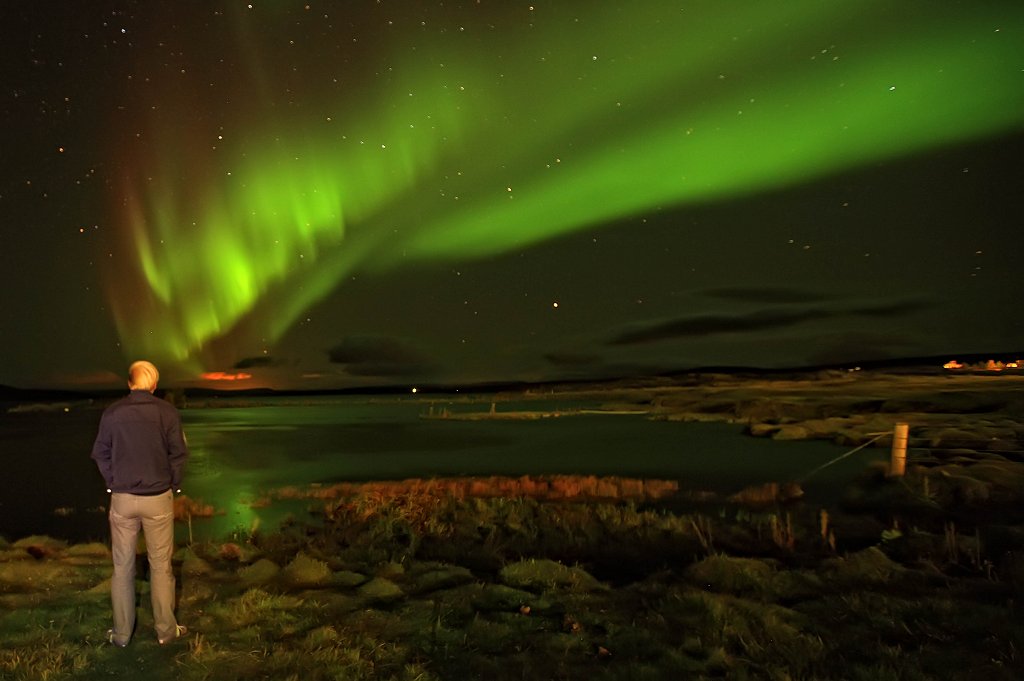
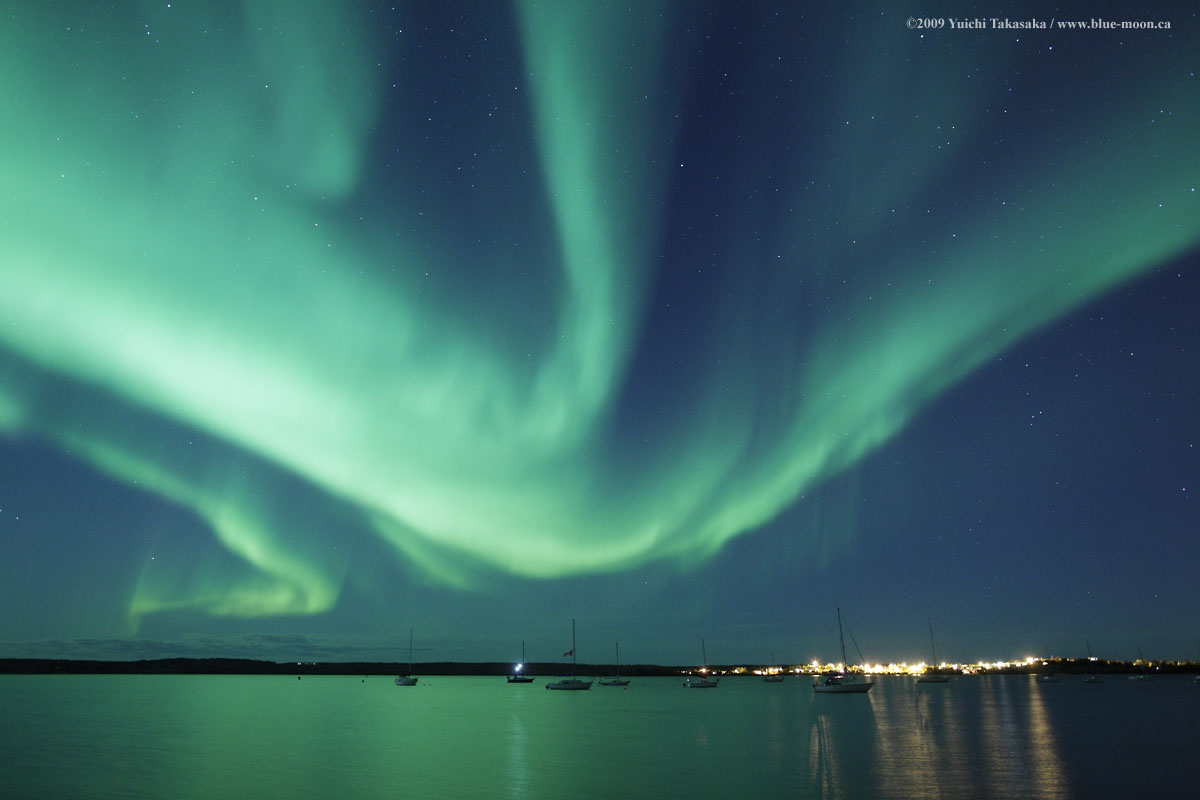
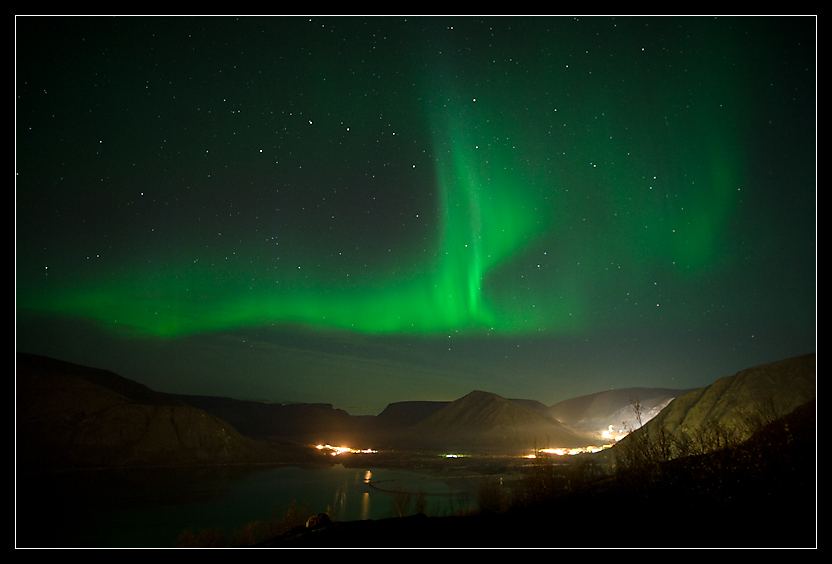
Northern Autumn marks the beginning of Aurora Season

The coming of Northern Autumn marks the beginning of aurora season. Sky watchers around the arctic circle should be alert for Northern Lights in Sept. and Oct.

Click Photos To Enlarge.

Lake Myvatn, Iceland Sept. 17, 2009

North Pole, Alaska Sept. 15, 2009

Yellowknife, Northwest Territories, Sept. 11, 2009

Kola peninsula, Russia, Mt. Khibiny Sept. 14, 2009

19 September 2009

Little Crater Targeted for Big Splash

Lunar crater Cabeus A1

Planetary scientists won't get a re-do when NASA's LCROSS spacecraft and its Centaur carrier rocket slam into the Moon on October 9th. They've got one chance only to strike a permanently shadowed and presumably water-rich crater floor near the lunar south pole. So for weeks they've anguished over where ground zero will be. As noted by project scientist Anthony Colaprete notes, the selection process spawned a "vigorous debate" among researchers.

With just under a month to go, they've announced their choice: an unnamed 11-mile-wide (17-km) craterlet astride the rim of Cabeus A. It's got desirable target characteristics — a flat boulder-free floor, for instance, and a location favorable for telescopes back on Earth to watch the resulting plume of debris that should balloon above the crash site.

Mostly, they've picked what they've dubbed Cabeus A1 because it's what one official calls a "sweet spot," a spot where detectors aboard the Lunar Reconnaissance Orbiter (which accompanied LCROSS to the Moon) hint that the always-dark dust might contain roughly 1½% water ice.

Neither Cabeus A1 nor nearby Cabeus A were on the list of candidate target craters announced back in July, and frankly the project's pick is surprisingly far from the lunar south pole (latitude –81½°). This is good news for both professional and amateur astronomers hoping to catch a glimpse of the impacts.

Officials aren't saying how much they've determined about the crater, but LRO carries two instruments that potentially could have moved the bull's eye squarely onto Cabeus A1.

One is the Lyman-Alpha Mapping Project (LAMP)can literally see in the dark, using reflected ultraviolet radiation from starlight to image the permanently shadowed lunar terrain.

Meanwhile, the Lunar Exploration Neutron Detector (LEND) can detect the presence of hydrogen, which almost has to be in water ice, down to 100 parts per million. LEND was built by the Moscow's Space Research Institute, and as best I know this is the first and only time a Russian-built instrument has flown on one of NASA's spacecraft (not counting the International Space Station).

At today's press briefing, Daniel Andrews (LCROSS project manager at NASA-Ames Research Center) assured everyone that the spacecraft was ready for its big finale. The team had a scare last month when an errant sensor caused wild thruster firings that squandered about half of the spacecraft's maneuvering fuel. Andrews also announced that the LCROSS mission has been dedicated to the memory of the late Walter Cronkite, the longtime television news reporter and anchor who followed NASA's missions from the Mercury program in the early 1960s to Space Shuttle.

So now it's time to start getting ready to observe lunar fireworks on October 9th. The timing, 4:30 a.m. Pacific Daylight Time, favors the big guns atop Mauna Kea in Hawaii in throughout western North America.

Sadly, I'll be in Puerto Rico that week — attending, ironically, a meeting of planetary scientists. Will someone please let us all know how things turn out?

12 September 2009

Refurbished Hubble Shows Its Stuff

Butterfly Nebula (aka Bug Nebula)

After the huge success of the Hubble Space Telescope repair mission last May, and the nailbiting suspense as astronauts wrestled to swap out much of the telescope's gear, the world was eager for new pictures and science. But it has taken several months to test and calibrate the new instruments and bring everything up to speed.

The first big public release was an unscheduled image of a surprise event: the appearance in mid-July of a black impact mark in Jupiter's south polar region. Now Hubble's handlers are throwing their previously scheduled coming-out party.

From a NASA press release:

"Topping the list of new views are colorful, multi-wavelength pictures of far-flung galaxies, a densely packed star cluster, an eerie "pillar of creation," and a "butterfly" nebula. Hubble's suite of new instruments allows it to study the universe across a wide swath of the light spectrum, from ultraviolet all the way to near-infrared. In addition, scientists released spectroscopic observations that slice across billions of light-years to probe the cosmic-web structure of the universe and map the distribution of elements that are fundamental to life as we know it.

"This marks a new beginning for Hubble," said Ed Weiler, associate administrator for NASA's Science Mission Directorate at NASA Headquarters in Washington. "The telescope was given an extreme makeover and now is significantly more powerful than ever, well-equipped to last into the next decade."

Leading the morning press conference was Sen. Barbara Mikulski (D-MD), who can take credit for pushing the repair mission to happen despite NASA's initial reluctance. “I fought for the Hubble repair mission because Hubble is the people’s telescope,” said Mikulski, chair of the subcommittee that funds NASA. “I also fought for Hubble because it constantly rewrites the science textbooks. It has more discoveries than any other science mission. Hubble is our greatest example of our astronauts working together with scientists to show American leadership and ingenuity."

05 September 2009

Jupiter dominates the Evening Sky & Dazzling Venus the Morning Sky


Jupiter continues to dominate the evening sky. Based on the comments left on this blog, many people have been noticing Jupiter in the southeast sky during the evening. At magnitude -2.8, Jupiter is ~13 times brighter than the brightest stars in the sky this month. Of all the planets, only Venus, and on very rare occasions Mars, are brighter.

Sept_VenusMoon


Venus is the brightest “star” in the sky a hour or so before dawn. It was at its highest in the morning sky last month but now begins its slow crawl lower though it will remain an easy object for early risers  over the next 2-3 months. For binocular and telescope users, Venus will appear nearly full and is much smaller than it appeared this spring (now 12″ across versus 50″ last spring).