24 June 2011

Springtime at Mars’ south pole

Mars’ south pole

ESA’s Mars Express celebrates eight years in space with a new view of ice in the southern polar region of Mars. The poles are closely linked to the planet’s climate and constantly change with the seasons. Their study is an important scientific objective of the mission.

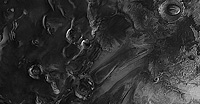
region around Ulyxis Rupes

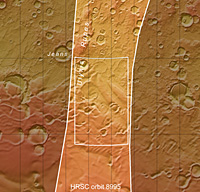
Ulyxis Rupes in context
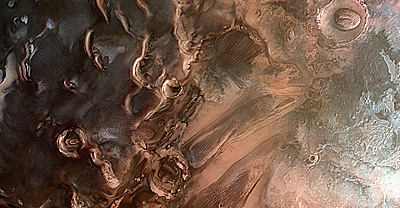
About two-thirds of the image is covered by part of the southern polar ice cap and other scattered ice deposits, near a feature known as Ulyxis Rupes. The left side of the image is dominated by the polar cap’s ice shield, which is covered by dark dusty material that hides the bright ices beneath.

At this location, further than 1000 km from the south pole itself, the ice is relatively thin: radar data indicate it is only about 500 m thick, whereas near the south pole it can reach more than 3.7 km.


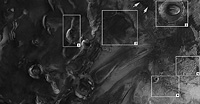
Features near Ulyxis Rupes

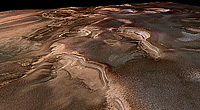
However, on the north-facing cliffs the layers of ice and dust are discernible. These form part of the polar, layered deposits. The cliffs are often curved, which could mean that they are shaped by underlying impact craters.

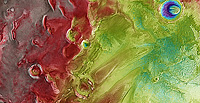
The elevation of this region decreases markedly from south to north, dropping in steps by about 1500 m in total from left to right across the image.

Elevation of Ulyxis Rupes

Elevation of Ulyxis Rupes
Just northward of the ice shield, about halfway across the image, there are large ice deposits that are heavily covered by overlying material blown into long dunes by the prevailing winds in this region. The orientation of the dunes suggests the wind must come predominantly from the northwest.


Ulyxis Rupes in high resolution

With increasing distance from the south pole, ice becomes confined to larger impact craters, such as the one in the top right of the image. These provide the best shelter. The ice itself is slightly offset towards the north because, with the sunlight coming from the north, the southern walls of the crater tend to warm up more, causing the ice to melt.

Ulyxis Rupes is a large cliff and is the only named feature in this image (‘rupes’ is the Latin term for cliff). With a length of 390 km and a height of up to 1 km, it is just visible at the top right of this image where it intrudes on the immediate left of the crater there.

Ulyxis Rupes in perspective

Ulyxis Rupes in perspective
Puzzling parallel structures in the martian dust can be seen in the bottom right quarter of the image. Although their origin is uncertain, it is possible that they are the result of underlying ice deposits, permanently frozen because they are protected by overlying dust and rocks.

The image was taken in January 2011, during the southern spring on Mars. At the moment it is summer there, but when the southern winter begins in March 2012, the temperatures will drop again and more ice will accumulate. Mars Express will be waiting.

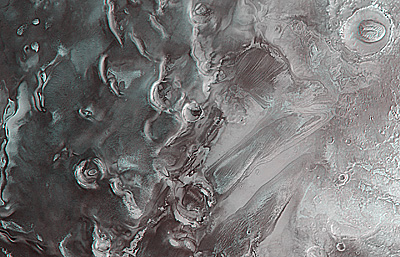
Ulyxis Rupes in 3D
Ulyxis Rupes in 3D

11 June 2011

June 15th's Deep, Eastern Lunar Eclipse

June 15th's total lunar eclipse
During June 15th's total lunar eclipse, the lunar disk will spend
100 minutes completely inside Earth's umbral shadow.

We're in the midst of an interesting eclipse trifecta. Partial solar eclipses occur during the New Moons on June 1st and July 1st, which are sandwiched around a total lunar eclipse during the Full Moon on June 15th.

Unfortunately, none of these are really visible from North America — which is too bad, because this lunar eclipse should be a doozy. Those of you in Europe and elsewhere in the Eastern Hemisphere are in for a real treat.

The Moon will plunge deeply into Earth's shadow, passing almost directly through its center. Consequently, totality lasts a whopping 100 minutes — the longest umbral immersion since July 2000, and nearly 40 minutes longer than the well-observed lunar eclipse last December 21st.

The lunar disk first encroaches into the penumbra, Earth's partial shadow, at 17:25 Universal Time, but don't expect to see any dusky shading along its easternmost edge for at least 30 minutes afterward. The first nibble from Earth's deep umbra comes at 18:23 UT, with the black bite taking a full hour to creep steadily across the disk.

Totality begins at 19:22:30 UT and ends at 21:02:42 UT, with the moment of greatest eclipse at 20:12:37 UT.

The long duration of this event is due in part to Earth being near aphelion in its orbit and the Moon being near perigee in its orbit. Since the lunar disk passes 5.3 arcminutes north of the umbra's center, observers might see the northern limb appear a little brighter than the southern limb.

In any case, this has the makings of a very dark eclipse. Observers rate totality's darkness using a five-point scale developed by French astronomer André Danjon, ranging from L = 0 (nearly invisible) to L = 5 (bright copper-red or orange disk). (Click here to learn more about the Danjon scale and other eclipse tips.)

David Dunham points out that the darkened lunar disk makes it very easy to watch the Moon cover up stars along its path. "Especially good will be the occultation of 4.8-magnitude 51 Ophiuchi," he notes. "Perhaps a naked-eye event, it will be spectacular as seen with binoculars or any small telescope." Click here to get a full listing of stars to be occulted during the eclipse.

Visibility map for June 15's lunar eclipse
The total lunar eclipse on June 15, 2011, favors observers in the Eastern Hemisphere. Click on the map for a larger version.
As the map at right shows, the ringside seats for Wednesday's event will be centered around 50°E in longitude. This favors eastern Africa (near moonrise), Asia, and western Australia (near moonset). Those of you in Europe will see most everything, though the early stages occur before the Moon rises. Only northern Scotland and Scandinavia miss out — but, then again, they were favored for the partial solar eclipse on June 1st.

Those of us stuck in North America won't see any of this eclipse by eyeball, but we'll be able to watch it vicariously thanks to the following live webcasts:

Later this year, on December 10th, most North Americans will have a chance to see a total lunar eclipse. Let's hope for clear weather!

22 May 2011

Do Planets Outnumber Stars ?

Rogue planet
An artist's portrayal of a rogue planet drifting alone through interstellar space, lit only by starlight.

Ask an astronomer how many stars populate the Milky Way, and the usual answer will be 200 to 400 billion. It's not that all those suns have actually been counted; instead, it's a statistical guesstimate based on the census in our immediate interstellar surroundings.

But a new study, published in today's issue of Nature, suggests that a complete census of "big bodies" drifting loose in our galaxy might actually total nearly one trillion — because Jupiter-mass "planets" in interstellar space might well outnumber the stars themselves.

The evidence for this sudden glut of planet-mass objects results from a dedicated search by two teams of observers: the Microlensing Observations in Astrophysics (MOA) Collaboration and the Optical Gravitational Lensing Experiment (OGLE) Collaboration.

In 2006-07, the MOA and OGLE teams used telescopes in New Zealand and Chile, respectively, to monitor the brightnesses of 50 million stars located in the huge stellar bulge surrounding the Milky Way's center. Instruments recorded the brightness of each star at least once per hour. After boiling down all that data, the teams found that 474 stars had briefly surged in brightness in a way that indicated gravitational lensing of their light by unseen foreground objects passing nearly front of them. During these incidental syzygies, the gravity of the foreground object bends and concentrates the light from the background star — an event known as microlensing.

Microlensing searches aren't new: they've long been used to search for massive dim or dark objects in the galaxy. But the MOA and OGLE teams found that 10 of these little surges lasted less than two days — too short to be caused by stars but just right for Jupiter-mass objects. Based on these statistics, the teams estimate that big planets must be far more common than believed and in fact must outnumber all the Milky Way's normal stars by about two to one.

Surprisingly, during these 10 brief events there were no corresponding lensing surges to betray the presence of nearby stars. So the observers conclude that these "Jupiters" must either be at least 10 astronomical units from their host stars (at least Saturn's distance from the Sun), or they are orphans drifting freely across interstellar space. They're more likely to be free-floaters, because previous direct-imaging searches found that giant planets rarely exist in very wide orbits.

"The implications of this discovery are profound," notes lensing specialist Joachim Wambsganss (Heidelberg University) in an accompanying Nature perspective.

Theorists are chuckling, "We told you so!" They've argued for years that the galaxy should teem with unbound planets. Some have proposed that objects with masses almost as low as Jupiter's form the way normal stars do, directly from collapsing clouds of gas and dust. Think of these as undersized brown dwarfs. Others point out that the chaos that seems to prevail in many just-formed solar systems must cause many close encounters among planets that yield "winners" (those that remain in orbit) and "losers" (those that get flung out of the system entirely).

Taken at face value, the MOA-OGLE statistics imply that most of the loose planet-mass objects aren't just low-mass stellar wannabes — there are too many of them. Instead, the researchers believe they're finding bodies that have been ejected from unstable planetary families — and, by extension, that planetary systems should be the norm, not the exception, for the Milky Way's hundreds of billions of stars.

This also implies that early chaos in planetary systems is common. Exoplanet researchers had already concluded that this is the case from the large number of explanets that have been left in highly eccentric orbits, which they could not have formed with.

07 May 2011

The Four-Planet Dance of 2011


If you can find a spot with a completely unobstructed eastern horizon, you can watch an extraordinary sky show from late April 2011 through the end of May. Every morning just before sunrise, four planets combine to form fascinating and ever-changing patterns. This is the tightest grouping of bright planets that has occurred yet in the 21st century.

If you live in the Southern Hemisphere, you can watch the whole show with your unaided eyes, but you will need binoculars to appreciate it properly from mid-northern latitudes. Go outside 45 minutes before sunrise and scan the eastern horizon until you find a planet. You're sure to spot either Venus or Jupiter first, because these are by far the brightest of the four.

Venus appears at just about the same spot every morning in May — just 2° or 3° above the horizon 45 minutes before sunrise for observers at mid-northern latitudes, and rising 3° higher each 15 minutes after that. If you pay attention to its location, you can probably continue to see it without optical aid long after the Sun rises.

Jupiter is very low at the beginning of May, but it passes Venus on May 11th and ends the month more than 12° above the horizon 45 minutes before sunrise. So by mid-May, you're likely to spot Jupiter before Venus despite the fact that it's less than one-quarter as bright.

Mercury is the 3rd-brightest planet in the grouping, but it's five to ten times fainter than Jupiter, and quite low in the sky. So you're likely to need binoculars to spot it. It tracks Venus's motion, staying a few degrees to the lower left of the brighter planet throughout this period.

Mars is quite faint, just one-hundredth as bright as Venus. It starts May very low in the sky, but catches up with the Venus-Mercury pairing around mid-month.

A thin crescent Moon joins the show from April 29th to May 2nd and again on May 29-31.

30 April 2011

See the Eta Aquarid Meteor Shower


Here's the Eta Aquarid's radiant as seen from latitude 30° north
(Houston, Cairo, Delhi, Shanghai) 90 minutes before sunrise. Farther
north, the radiant is even lower when the sky starts to get light. But
Eta Aquarids are occasionally seen as far north as the Mid-Atlantic
States.


The Eta Aquarids might be the best meteor shower that you've never heard of. This shower is caused by flecks of dust released from the nucleus of Halley's Comet. It stays near full strength for five days — longer than any comparably intense shower — and its meteors are bright and plentiful.

So why isn't it better known?

If you live in the Southern Hemisphere, where this is arguably the year's best meteor shower, you've very likely heard of it. But relatively few Eta Aquarids are visible from mid-northern latitudes, where the lion's share of amateur astronomers live. Still, this shower puts on quite a respectable show in the southernmost tier of the United States. And because the meteors are so bright, they're occasionally seen much farther north than that during morning twilight — and even broad daylight.

Conditions are ideal for the Eta Aquarids this year, because the Moon is absent from the sky during the predawn hours. The shower is forecast to peak on the morning of Friday, May 6th, with good activity from the 4th through the 8th.

As the name Eta Aquarids suggests, all of this shower's meteors appear to radiate from a spot near the northeastern corner of the constellation Aquarius. The higher a shower's radiant is in the sky, the more meteors you can see, and you won't see any meteors at all when the radiant is significantly below the horizon.

In the case of the Eta Aquarids, the radiant doesn't rise until long after midnight, and it reaches its highest in the sky well after sunrise. So the best time to watch for meteors is anywhere from one to two hours before sunrise. Earlier than that, the radiant is too low — any later, the sky is too bright.

16 April 2011

So-So Prospects for Comet Elenin


Comet Elenin on March 14, 2011

Comet Elenin on March 14, 2011

Last December, comet-lovers got a bit of an adrenaline rush when they learned that a new object, Comet Elenin (C/2010 X1), might reach naked-eye brightness a week or so after it reaches perihelion on September 10th.

It's still early in the game, but reports from visual and photographic observers over the past few weeks have tempered expectations somewhat.

Those looking for Comet Elenin by eye have found it elusive. Only two observers — Jakub Koukal, using a 9½-inch (24-cm) reflector in the Czech Republic; and Juan José González Suárez, using an 8-inch Schmidt-Cassegrain in Spain — feel certain they glimpsed it by eye in early April. But it was a no-show for comet-hunter Alan Hale, who had a larger telescope at a pitch-black site 7200 feet (2200 m) up.

Another consideration is that the visual estimates (magnitude 15.3 and 14.9, respectively) are at odds with CCD observations suggesting something no brighter than magnitude 16. Such differences would make sense if Comet Elenin were somewhat diffuse, but everyone agrees that it's strongly condensed and almost stellar in appearance.

Koukal and González are veteran observers who carefully checked their sightings against faint nearby stars. Even so, former S&T columnist John Bortle, who's watched comets come and go for more than 50 years, is skeptical of visual sightings made at the hairy edge of a telescope's capability. "I can cite many instances of 'positive' observations turning out to be spurious, even when made by experienced observers," he notes.

For now, who can or can't see it doesn't matter much, as the interloper is still heading inward and won't get seriously worked up for several months. But the comet cognoscenti have already started calling it "intrinsically faint," and it's becoming clear that hopes for a nice eyeball-easy showing have dimmed considerably.

Best guesstimates now suggest that Comet Elenin's total brightness might peak near magnitude 6 in mid-September — a nice binocular object — presuming that it survives its dash through perihelion just 45 million miles (0.48 astronomical unit) from the Sun.

Meanwhile, you have my permission to ignore or refute any of the wacky postings about the supposed danger posed by Comet Elenin. All this nonsense seems to have started back in January, when edge-of-reality blogger Laura Knight Jadczyk made provocative warnings — all based on information from a member of her research team who's "an astronomer at a large observatory". (Yea, right.) It's not even worth giving you a link to her ramblings.

03 April 2011

MESSENGER: Mercury Surface,

First Image Ever Obtained from Mercury Orbit
Click on image to enlarge.

Early this morning, at 5:20 am EDT, MESSENGER captured this historic image of Mercury. This image is the first ever obtained from a spacecraft in orbit about the Solar System's innermost planet. Over the subsequent six hours, MESSENGER acquired an additional 363 images before downlinking some of the data to Earth. The MESSENGER team is currently looking over the newly returned data, which are still continuing to come down. Tomorrow, March 30, at 2 pm EDT, attend the NASA media telecon to view more images from MESSENGER's first look at Mercury from orbit.

The dominant rayed crater in the upper portion of the image is Debussy. The smaller crater Matabei with its unusual dark rays is visible to the west of Debussy. The bottom portion of this image is near Mercury's south pole and includes a region of Mercury's surface not previously seen by spacecraft. Compare this image to the planned image footprint to see the region of newly imaged terrain, south of Debussy. Over the next three days, MESSENGER will acquire 1185 additional images in support of MDIS commissioning-phase activities. The year-long primary science phase of the mission will begin on April 4, and the orbital observation plan calls for MDIS to acquire more than 75,000 images in support of MESSENGER's science goals.

On March 17, 2011 (March 18, 2011, UTC), MESSENGER became the first spacecraft to orbit the planet Mercury. The mission is currently in its commissioning phase, during which spacecraft and instrument performance are verified through a series of specially designed checkout activities. In the course of the one-year primary mission, the spacecraft's seven scientific instruments and radio science investigation will unravel the history and evolution of the Solar System's innermost planet. Visit the Why Mercury? section of this website to learn more about the science questions that the MESSENGER mission has set out to answer.